Living like a local in Greece
by Marvin Herman, Delavan, WI
Rumors of strikes, riots in the streets and a collapsed economy did not deter us from planning our October ’10 journey to Greece. As my wife, Judy, and I had done several times before on trips abroad, we enjoyed meeting the challenges of independent travel and did our best to protect ourselves from the anticipated glitches that were bound to arise.
Making arrangements
We arranged for all of our accommodations online, opting for hotels with lower, noncancelable rates wherever available. Our credit card, a Chase Sapphire MasterCard (800/940-7592) with no annual fee, provides a decent trip-insurance policy that protects against forfeitures.
For the first time in our travels, we armed ourselves with a cell phone to use on our journey. It was rented from
Cello Mobile (877/602-2999 or 212/444-9079) for $41.79 for the month we had it. Call charges were 69¢ per minute.
They gave us a UPS mailing label for easy return ($10) at the end of the trip, plus a charger, adapter and easy-to-follow instructions. The phone gave us additional assurance that we could meet any challenge that arose, and we would certainly rent one for any future independent travel.
For our stay in Athens, we rented an apartment through Vacations-Abroad.com for €75 ($107) per night, payable in cash on arrival. It was located in a quiet neighborhood south of the Plaka, within walking distance of the Acropolis and near the Syngrou-Fix Metro Station. It had two large bedrooms; a washer/dryer; TV (no English channels); all required kitchen appliances, dishes and utensils; free use of a computer, and a nice terrace.
Evangelos, the owner of the apartment, was very helpful, providing a map in advance so we could easily find the apartment from the Metro station. The Metro senior fare from the airport to our stop was €3 each.
The Athens Metro is the most modern system we have seen in Europe. The trains are clean, efficient and fast, and the signage is more than adequate for visitors. This infrastructure, like much in modern Athens, was improved for the 2004 Olympics.
Settling in
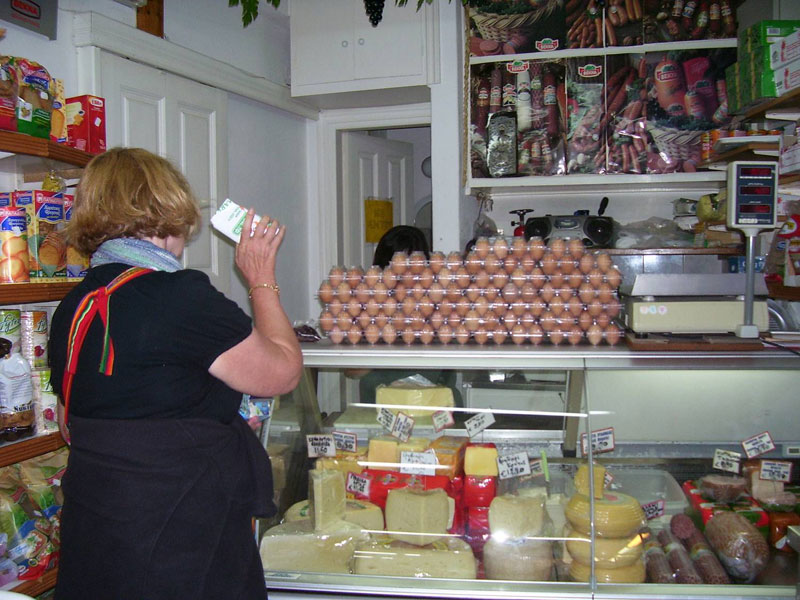
After settling in, we found a supermarket where we could stock up on olives, tomatoes, feta cheese, yogurt and coffee, and there was a bakery on the corner of our block where I would go to buy fresh bread each morning. We enjoyed being regular neighborhood people and, after the first day, we would be greeted by people whom we had previously encountered on the streets or in stores.
On our first morning in Athens, we walked over to Syngrou Avenue, a main thoroughfare, to find a travel agent who would sell us tickets for the ferries that we planned to take later in our journey. We didn’t book these online because we wanted to get a better idea of what the weather would be like. As it worked out, the weather was excellent and we were able to buy our ferry tickets in Athens.
That morning, on our way to the Parthenon, we also got a fix on the location of the Hertz car-rental office from which we would rent a car a few days hence on our departure from Athens. We had arranged, online, for an automatic-transmission vehicle through
Auto Europe (Portland, ME; 888/223-5555. The cost was about $330 for the week we had the car.
Around Athens
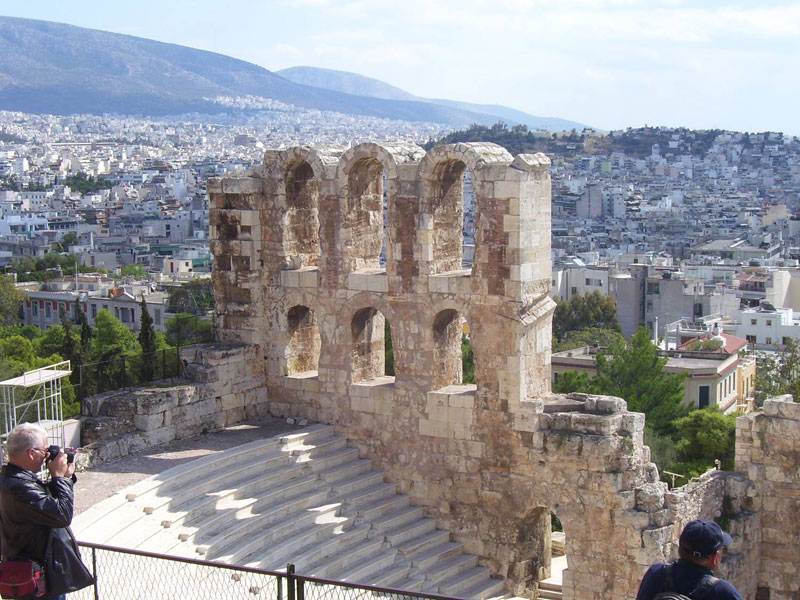
In Athens, we also visited the National Archaeological Museum (28 Octovriou [Patisslon] 44) and spent several hours following the early history of Greece, from about 3000 BC to AD 476, the end of the Western Roman Empire.
A five-euro taxi ride took us from the museum to the Central Market. We walked through wonderfully boisterous meat and fish markets complete with vendors shouting about their wares amid butchers wielding cleavers and knives that flashed as they sliced through tendon and muscle, scales and gills.
In the center of it all was a small restaurant, where we stopped for a meal of Greek meatballs and grilled lamb, all wonderfully fresh and served with roasted potatoes, garlicky bread and sautéed dandelion greens. Washed down with a half liter of cold rosé, it cost €24 for the two of us.
Returning to our apartment, we stopped to pick up dessert at “our” bakery and enjoyed the freshly baked baklava (a Greek phyllo-dough dessert with honey) with coffee on our terrace.
The next morning we set off for the Numismatic Museum, not because we are coin collectors but because it is the former home of Heinrich Schliemann, the German archaeologist who excavated Troy and, later, Mycenae. It is a large home, nicely restored and worth seeing if you, like Judy, are a fan of this man and the ruins he dug up.
We also visited the Jewish Museum. Before WWII there were more than 75,000 Jews in Athens. Today there are around 3,000. The museum endeavors to be a symbol of the struggle to establish a Jewish community in Athens.
Driving in Delphi
By 9 o’clock the next morning we were in the Hertz office to get our car. An officious woman filled out our paperwork and gave us instructions and some directions. We had purchased a good road map of Greece (Michelin Map Greece No. 737) from Amazon.com before we left home. We loaded up our luggage and headed for Delphi.
I have driven in many European countries and I found the roads in Greece to be above average. From my fraternity days I remembered the Greek alphabet, and it was of help in reading the directional signs and the names of towns that we passed.
Soon we arrived in Arachova, a small town near Delphi where we checked into
Hotel Likoria (phone +30 22670 31180), a charming, quiet and modern little place at the far end of town. It had a small parking lot across the street, and our room had a view of Mt. Parnassus.
Soon after settling into our room (€86 per night, including a mediocre breakfast), we were hungry for a late lunch. Walking through the little town, we smelled the smoke of a wood fire near a sign that read “Taverna Arachova — 30 meters,” with an arrow pointing down a long set of steep steps. I investigated and hailed Judy from below.
A mountain view and a crackling fire were the backdrop for another wonderful meal (€36 total). A liter of the house rosé and a baked eggplant appetizer started us off. Judy ordered her favorite, roasted lamb and potatoes, and I had roasted chicken in a savory sauce and the ubiquitous crusty bread.
After our shared dessert pastry, we noticed that our waitress, the wife of the chef, was being fêted with a cake for her 44th birthday. We joined with her family in wishing her well and she shared her cake with us.
We soon departed the taverna (phone 22670 31418), but Judy forgot her purse. The birthday celebrant ran most of way up the steps to return it.
The next morning we drove about 15 minutes to the Delphi Archaeological Museum, which houses and identifies many of the objects found at the Delphi Sanctuary of Apollo. Afterward we went to explore the site where these objects were located in antiquity.
We found that Rick Steves’ “Athens and The Peloponnese” was a great guide for our exploration of the places on the Greek mainland.
We next visited the town of Delphi and did some souvenir shopping. It was the end of the tourist season and shops advertised large discounts. In fact, the prices were very high, we felt, so our purchases were minimal.
On to Olympia
The next day, we left for Olympia and the popular archaeological site of the first Olympic Games. We visited the ruins, the athletic fields and the workshop of Pheidias, the sculptor of the famous statue of Zeus on his throne.
The Olympic site was crowded with tour groups, and we were pleased to be able to see the site on our own and at our own, slower pace. We also visited the small museum nearby that houses many of the wonderful treasures from the site.
We then drove to
Bacchus Tavern (phone +30 26240 22298), in Ancient Pissa, operated as a pension by Zapantis Costas and his sister Maria. Our room (€76, including an excellent breakfast) was small but had a wonderful view of the surrounding olive groves and hills.
When we went to pay the bill with a credit card the next morning, we were told that the card machine was broken and we would need to pay in cash. After I said that I didn’t have cash, my credit card was accepted and the charge went through the “broken” machine. A similar scenario played out many times during our travels in Greece.
At gas stations, always ask the attendant,
before you fill up, if credit cards are accepted. Once the tank is full, the answer will likely be “No.”
Mycenae and Nafplio
We drove over scenic mountain switchbacks toward Tripoli and on to our rental apartment in the small town of Kiveri, about five miles from the larger city of Nafplio. We found the rental at
www.holiday-rentals.co.uk (
listing No. 413446). Located at the end of the town, it offered a view of the Argolic Gulf from its large terrace.
When we arrived, the rental agent, Socrates Grecos, in response to our earlier call, had arrived on his motorbike to help us settle in and we signed his lease form. The rent (€60) had been paid to the owner, a resident of Washington, DC, in dollars before we left the US.
Once Socrates left, we struggled with the washing machine, finally realizing that the water faucet needed to be turned on.
In Greece, it seems that many people leave appliances unplugged or turned off so they don’t further strain the fragile power grids. We were to notice that again later in our travels.
Our first full day in this area was spent visiting Mycenae and its acropolis. Excavated by Schliemann in the 1870s, it is a magnificent ruin.
The city of Nafplio was our main target for the next day, but first we headed about an hour away to Epidavros (Epidaurus) to see its famous theater, stopping to admire a Mycenaean bridge along the way. In Nafplio, we parked on the street and walked to the big Saturday market. We asked for and received directions to the Old Town and drove to the port, where it was easy to find parking in the big, free lot.
We toured the Old Town, sharing a coffee gelato at Antica Gelateria di Roma (Farmakopoulou 3 at Komninou; phone 27520 23520), operated by the affable Marcello, who saw that we were set up with a seat, a glass of water, some cookies and a chance to use the loo.
Many shops in Nafplio were a cut above the usual tourist traps, so we found it worthwhile to browse them. Rick Steves’ book has a great tour of the area.
The plan for the next day was to return to Nafplio and climb to the Palamidi Fortress, said to be the best-preserved Venetian fort in the Mediterranean. But we know what they say about plans, however well laid.
We did drive to Nafplio, which was crowded with Sunday shoppers, families enjoying the harbor, parks and beaches, and many tourists. Judy decided to go shopping while I planned to ascend to the fortress.
As I headed up Polyzoidou Street from the parking lot at the harbor, toward Arvanitia Beach, I reached another parking lot, turned left and found myself on the six-kilometer Nafplio-Arvanitia trail. With the gulf on my right and the mountains on my left, I decided to join the many locals on this wonderful scenic walk, which took me about two hours.
Mykonos and Delos
After dropping our rental car off in Piraeus, we took a cab (€7) to the port and eventually boarded a ferry to Mykonos. Our fare to Mykonos was €34.50 each. We had opted for the middle of the three classes of seats on all of our ferry trips.
I phoned our hotel in Mykonos from the ferry to confirm that we would be picked up. As we disembarked, we saw a young woman holding a sign with the name of our hotel,
Alkyon (phone + [0030] 22890 27366).
Sophia, who, along with her parents, runs Alkyon, was one of the most caring, hospitable hosts that we encountered in Greece. She spoke perfect English, amongst several other languages, and was congenial and helpful.
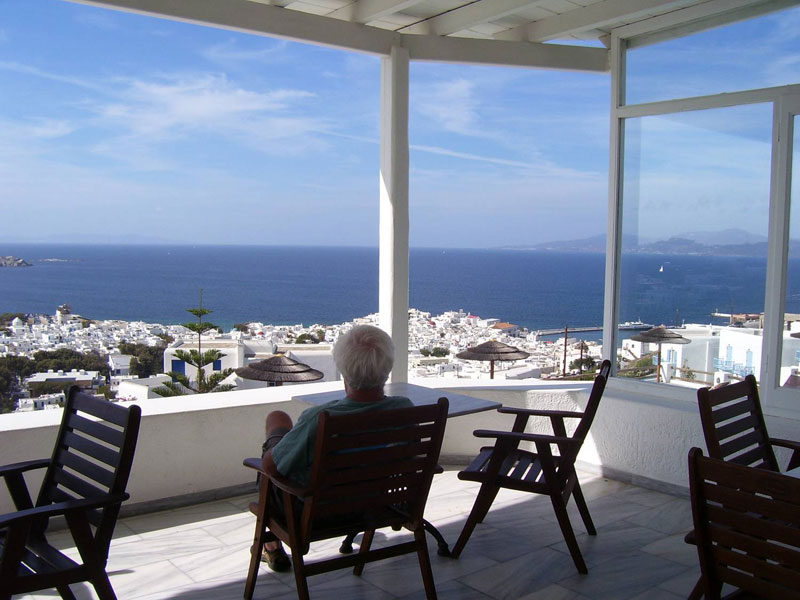
She showed us to our room (€60 per night, with breakfast) with its beautiful view of the Aegean Sea and, in the distance, the island of Delos.
By morning, the previous day’s rainy weather had cleared and we were off to the island of Delos. Sofia had a moment to drive us down the hill and direct us along the waterfront to the kiosk that sells the tickets for the ferry going to the island (€5).
The ferry was loaded with a mix of tourists of various ages and nationalities. The trip took about a half hour, and we sat on the top deck open to the sun and breeze. Once on Delos, we waited in line to pay the five-euro entry fee.
Delos is a very extensive archaeological site with temples dedicated to dozens of gods. With the map given to us at the entrance, eventually we were able to locate the various sites of interest.
We stopped at the free museum, which displays some artifacts from the site, then covered much of the island, including an amphitheater, gymnasium and agora. Even for persons without any substantial interest in archaeological sites, Delos is a very worthwhile destination for its views of the Aegean Sea and for the island, itself.
Back on Mykonos, our late lunch at one of the pricey seaside restaurants frequented by fashionably dressed young women with small dogs led us to conclude that life is not cheap on Mykonos. If Greece was a country in financial crisis, it didn’t seem to have reached Mykonos.
It rained during the night and the temperature fell to the 50s.
We set off to explore the town of Mykonos in the morning, letting ourselves get lost in the winding streets. Before leaving our hotel, we called ahead to Krokos Villas, our hotel on Santorini, to confirm that we would be on the hydrofoil the next afternoon.
We were informed that we had been given an upgrade to a room at the
Avaton Resort & Spa (phone +30 22860 28988), one of the sister properties of our originally booked accommodation, also located in the Imerovigli section of the island.
Checking the substituted resort on the Internet, we found comments on Tripadvisor.com to be quite favorable, so I sent an e-mail confirming our acceptance.
Santorini
After spending most of the morning transfixed by the beautiful view of the Aegean, it was time to move on. Sofia (what a treasure!) drove us down the hill to the hydrofoil, a double-hulled vessel much faster than a ferry, which took us to the island of Santorini for €41.50 each.
We were met at the boat dock by a taxi (€15) and taken to the Avaton Resort (€80 per night). At the walkway to the resort, Markos, whom we dubbed the “super porter,” helped with the luggage.
The nine-room resort is located on the edge of a cliff overlooking a caldera that is filled with water. Beyond its far rim lies the Aegean Sea.
Our smallish room, located near the outdoor pool, had a stunning view, a great shower and a complimentary bowl of fruit and bottle of wine.
The hotel did have a dining room, but it was located in the spa. Although guests don’t use the spa during dinner hours, we found it unappealing as a place to eat and took our meals elsewhere.
Using a map furnished by the hotel, we walked the seven minutes to the tiny town center of Imerovigli and ate at a nice taverna called Anestis (phone + 30 22860 25374). Choosing from the large selection of Greek dishes, we fell back on the familiar roasted lamb with potatoes and a large Greek salad (€22 with wine). After a stop at a bakery for some baklava, we walked back to the resort.
Unearthed in 1967, Akrotiri is a Minoan city on the southwest tip of Santorini. The site was later covered by a modern roof which, unfortunately, collapsed several years before our visit; the site was closed to visitors. We
did see many of the frescoes of Akrotiri at a museum in Fira, Santorini’s capital city, as well as in Athens.
The next morning was cool and breezy, but the temperature warmed throughout the day, reaching the low 70s. Outside our room, I sat in the small alcove overlooking the edge of the caldera and, beyond a sprinkling of low buildings, the sea. The quiet of Avaton was soothing — no boisterous tour groups here.
Markos brought our breakfast, wonderfully fresh and complete with a pot of steaming coffee; yogurt and honey; tomatoes; olives; eggs; feta cheese, and coffee cake. After breakfast, we walked about 25 minutes to Fira to visit the Museum of Prehistoric Thira and the Archaeological Museum, both quite small but each holding many artifacts from Minoan culture.
Our best dinner on Santorini was at a restaurant called Nikolas (Erythrou Stavrou), in Fira, where we enjoyed sea bass and lamb in a comfortable atmosphere (€40 for both of us).
Paros and Piraeus
We boarded the Blue Star Naxos ferry for the ride to our next island, Paros. We stowed our luggage down in the garage so we didn’t have to drag our bags up and down the escalator to the passenger areas. Though the bags weren’t secured, passengers didn’t have access to the area during the sailing.
Sitting on the open back deck of the ferry, I phoned the
Arian Hotel (phone +30 284 21490), our hotel in Paros, to get directions. It was a short walk from the ferry dock in Parikia, the principal town of the island.
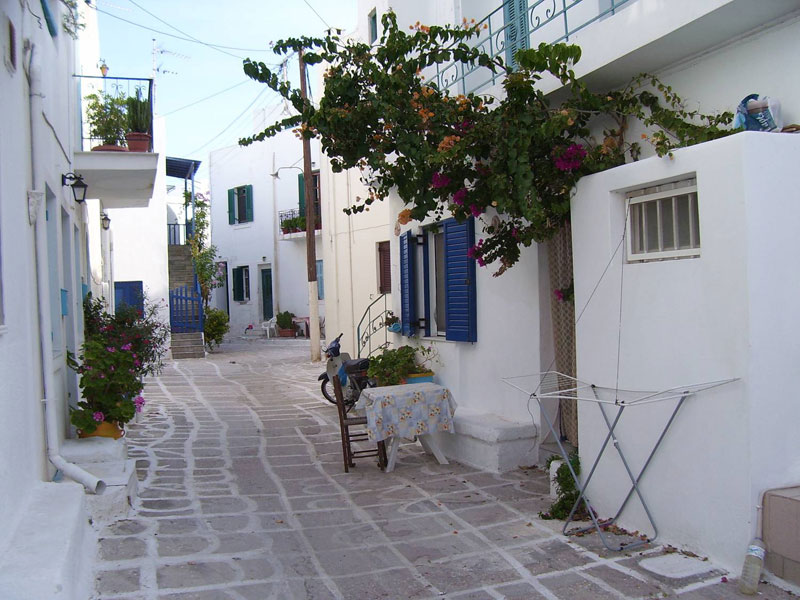
After a good night’s sleep (our room cost €38, not including breakfast at €10), we headed into Parikia, a town of winding white passageways.
After about an hour of wandering, including a visit to a Byzantine church with an immense chandelier, we stopped at Symposium, a small restaurant with outside seating. For €7.50 each, we had one of our best breakfasts in Greece. I had eggs, bacon, fresh breads and jam and Judy had eggs Benedict with ham.
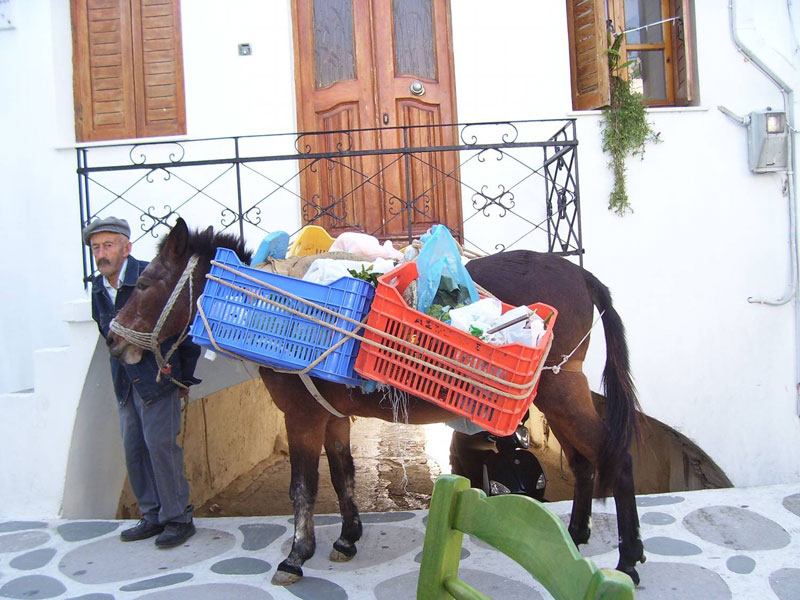
As we ate, a food peddler with a donkey cart came by to sell the restaurant fresh vegetables, and people opened shops nearby, greeting each other as friendly neighbors would in a small town.
At breakfast, we also got information on how to get the bus to Pounda, where we would take the ferry to Antiparos, a small island which has become a celebrity haunt since Tom Hanks and others have bought property there. Our round-trip bus tickets cost €3 each, and the ferry (leaving each half hour) cost €2 each way.
We walked to Antiparos’ center square and wandered the streets until we got lost. Then we returned to the main road, hopped the ferry and returned to Pounda, continuing by bus to Parikia.
The next morning, our last in the islands, we had breakfast at the port and watched as our ferry arrived for the 4½-hour ride to Piraeus (€19).
At Piraeus, we were besieged by taxi drivers but declined their services since we wanted to take the Metro to the
Sofitel Athens Airport (phone +30 210 3544000), the hotel we had booked for our last night in Greece. Unfortunately, due to a strike, the Metro was not running out to the airport.
We must have looked as if we needed help because a young woman soon asked if she could assist us. We explained our predicament, and she walked two blocks with us to show us where to catch a bus to the airport (€3.10).
The bus was not crowded and made few stops. We, again, felt we were traveling not as tourists but as the locals do.
Back in Athens
The bus dropped us off at the airport, across from our hotel (€155 for the night). Shunning the expensive fare at the hotel, we decided to eat dinner at the airport (€19 for both of us).
Sitting in the boarding area the next morning, we were advised that there would be a delay because of an air traffic controllers’ strike in Paris. As a result, we missed our connection to Chicago.
Air France offered us overnight accommodations in Paris or a flight to New York with a connection to Chicago. Anxious to be home, we chose the New York option.
When we reached JFK, we found that our connecting flight to Chicago was canceled due to windy weather in the Midwest. Air France offered to put us up at a hotel at LaGuardia and gave us a coupon for dinner, since the missed connection in Paris was not weather related.
This was an unforgettable trip. We saw three different parts of Greece over 23 days, at our own pace and in our own way. We found our own way around on local transportation and, if we decided to sleep late or skip dinner, we were able to do so.
We always felt secure, though neither of us spoke a word of Greek beyond “Please” and “Thank you.”
If any reader would like detailed information on how to plan and execute an independent trip, please feel free to e-mail us c/o ITN.
Not all trips lend themselves to this form of travel, but in the instances that do we find it a most satisfying and fulfilling method of travel.
 Sakchai Lalit, AP


 Photo by E01 on Flickr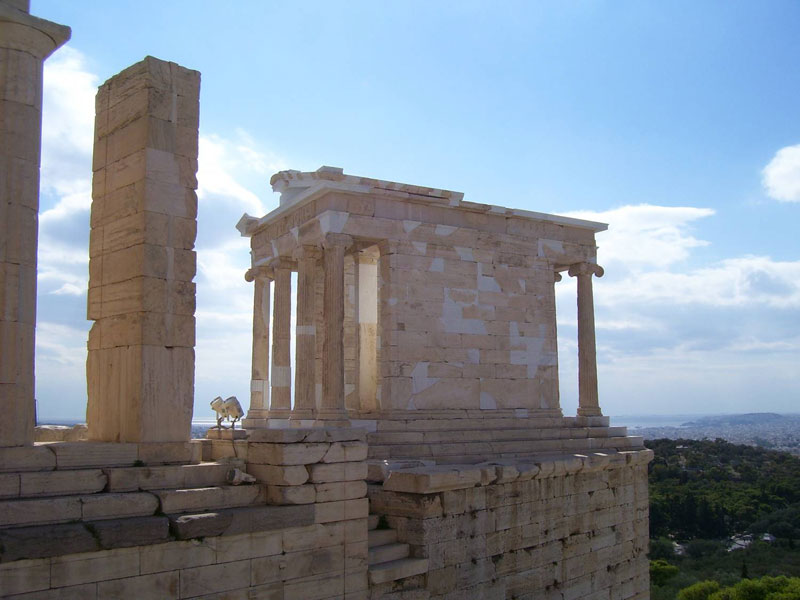
 In pictures: See the amazing Aircruise design